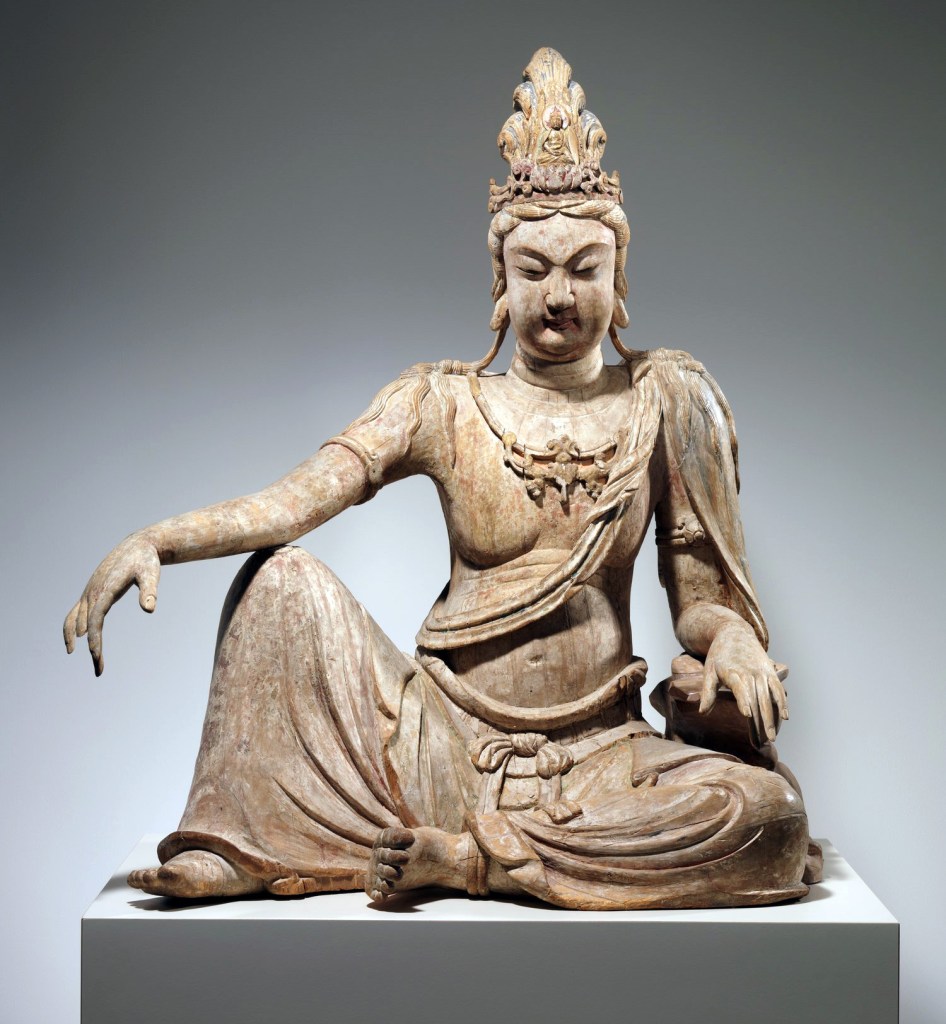
Wicca and witchcraft are fundamentally more aligned with traditions like Buddhism and Hinduism—as well as other animistic faiths—than Abrahamic religions due to their shared views on cyclical existence, cosmic cause and effect, the divinity of nature, and decentralized spirituality.
While Abrahamic faiths (Christianity, Judaism, and Islam) are typically built around linear time, divine revelation, a singular male creator, and strict orthodoxy, Wicca and Eastern dharmic paths operate on interconnected, fluid, and experiential frameworks.
When the founder of Wicca, Gerald Gardner, formalized the religion in the mid-20th century, he explicitly blended old European pagan folklore with concepts borrowed from Buddhism and Hinduism.
The Nature of the Divine
Immanence over Transcendance:
Wiccans and Buddhists often see the divine as part of the universe rather than outside it.
Wiccans view nature itself as sacred and divine.
Buddhists focus on an inner spiritual awakening rather than looking to a separate creator god.
No Supreme Judge:
Unlike Abrahamic religions (Christianity, Judaism, and Islam), these paths do not feature an all-powerful king-like God who hands down absolute commandments and judges humanity from above.
Cause and Effect
The Threefold Law and Karma:
Wicca teaches the Threefold Law, meaning the energy you put out into the world returns to you threefold.
This mirrors the Buddhist concept of karma, where every action has a natural consequence.
Personal Responsibility:
You are responsible for your own spiritual growth and actions in both paths.
You do not rely on a savior or a church hierarchy to forgive sins.
Views of Time and Nature
Cyclical Time:
Wiccans follow the Wheel of the Year, celebrating the changing seasons and cycles of life, death, and rebirth.
Buddhism also views time and existence as a continuous, cyclical wheel rather than a straight line.
Linear History Contrast:
Abrahamic religions view history as a straight line with a specific beginning and a final end time.
Practice Over Dogma
Experiential Truth:
Both traditions value direct personal experience over blind faith in holy books.
Ritual and Meditation:
Wiccans use ritual, magic, and energy work to connect with the universe.
Buddhists use meditation and mindfulness for the same goal.
Both methods focus on training the mind and spirit directly.

