What It Means to Be a Practitioner
To be a practitioner means to actively live your craft through consistent, hands-on application rather than just reading about it or treating it as a passive hobby. A practitioner is someone who translates esoteric philosophy, astrological cycles, and herbal lore into daily, intentional actions—whether that means brewing a ritual tea, meditating at an altar, or casting a spell. They take full accountability for their own spiritual growth, developing a personalized, experiential relationship with the unseen forces of nature and the psyche.
What a Traditional Practitioner Keeps in Their Cabinet
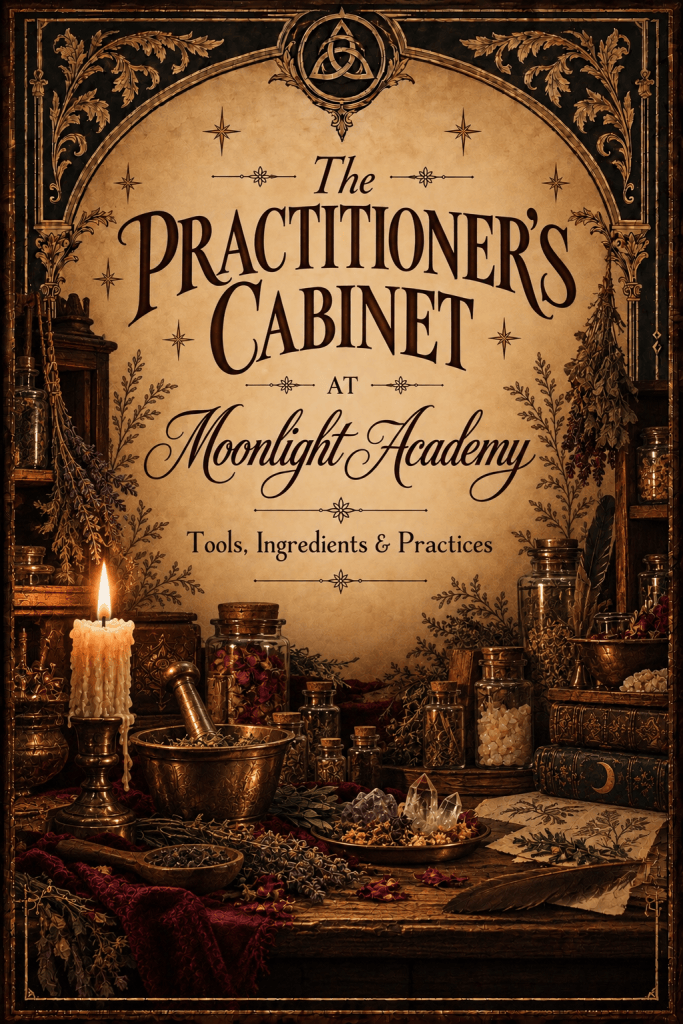
A practitioner’s cabinet (often called a witch’s cupboard or apothecary) is a practical toolkit, not a display of decorative curiosities. Historically and modernly, it contains a balanced mix of the elements and practical tools:
- The Botanicals (Earth): Jars of dried herbs like mugwort for dreaming, rosemary for memory and protection, lavender for calming, and locally foraged flora.
- The Tools (Air & Fire): Ritual tools like bundles of cleansing smoke, charcoal discs, a small cauldron, beeswax candles of various colors, a ritual knife (athame), and matches.
- The Waters & Oils (Water): Bottles of moon water caught during specific lunar phases, essential oils, Florida Water, and carrier oils like jojoba or almond for creating custom anointing blends.
- The Vessels & Media: Small glass vials for spell jars, cheesecloth, parchment paper, twine, and natural string to bind intentions.
🌙 Inside a Moonlight Academy Practitioner’s Cabinet (in theory)
If that practitioner is an active student or coven elder studying in the heart of Hollywood at the Moonlight Academy, their cabinet reflects a unique blend of rigorous academic study, mutual aid ethics, and highly tailored creative mysticism.
Because their Monday study halls ground them in Buckland’s workbooks, Batty’s educational models, and simultaneous hands-on academy workshops, their cabinet is a beautiful cross-section of a laboratory and an artist’s studio:
🧪 1. The Homework & Lab Vessels
- Coursework Inks & Parchment: Bottles of handmade iron gall ink or dragon’s blood ink, paired with calligraphy nibs. These are explicitly used during Monday Study Halls to meticulously transcribe their weekly coursework directly into their grimoires.
- Label Reagents: Rows of identical, clearly categorized amber dropper bottles. Because the academy’s framework is rooted in community healthcare workers and structured textbooks, ingredients aren’t just “magical”—they are labeled with botanical names, harvest dates, and astrological alignments (e.g., Salvia officinalis – Harvested on the Full Moon in Aries, 2026).
🧵 2. The Creative Mystic’s Materials
- Sacred Sewing Notions: Spools of natural cotton and silk thread, specialized needles, and scrap pieces of linen or velvet leftover from the academy’s ritual robe and altar cloth sewing workshops.
- Bookbinding Cord & Beeswax: Blocks of pure local California beeswax used to wax heavy thread for binding their own custom grimoires, alongside extra book-cloth or leather scraps.
🤝 3. The Mutual Aid Cache
- The “Give-and-Take” Stash: A designated shelf or bin of items meant for redistribution. This includes extra homegrown white sage or garden rosemary, extra spell jars, and thrifted text books (like duplicate copies of Cunningham or Buckland) ready to be brought down to the Monday night donation table for incoming beginners.
- Urban Foraged Remedies: Rather than overpriced, mass-produced crystals or commercially imported herbs, a Hollywood practitioner’s cabinet features jars of eucalyptus seed pods and lavender harvested ethically from the neighborhood or Pan Pacific Park, honoring the grassroots, non-capitalist roots of the Grove network.

